

The Portfolio Shift Hiring Managers Are Actually Looking For
One of the most common portfolio mistakes instructional designers make is this:
They build a gallery. Screenshots. Storyline interactions. Rise modules. Canva graphics. Vyond videos. Beautiful work, but no context.
And here is the hard truth. Hiring managers are not trying to hire your software skills. They are trying to hire your judgment.
Tools Do Not Differentiate You
Many applicants know Storyline, Rise, Vyond, Camtasia, and/or Captivate. Many can create assessments, branching scenarios, microlearning.
Tools are expected. Thinking is rare.
When a hiring manager opens your portfolio, they are quietly asking:
- What problem were you solving?
- Why did you choose this approach?
- What constraints did you face?
- What trade-offs did you make?
- What changed because of this design?
If those answers are not visible, your work becomes decorative instead of strategic.
What a Thinking-Driven Portfolio Looks Like
“This course was built in Storyline and includes knowledge checks.”
Try framing your project like the graphic below (use the 5-Part Framework Christy Tucker and I teach in our Portfolio Course). I have color coded it so that you can see each part of the framework.
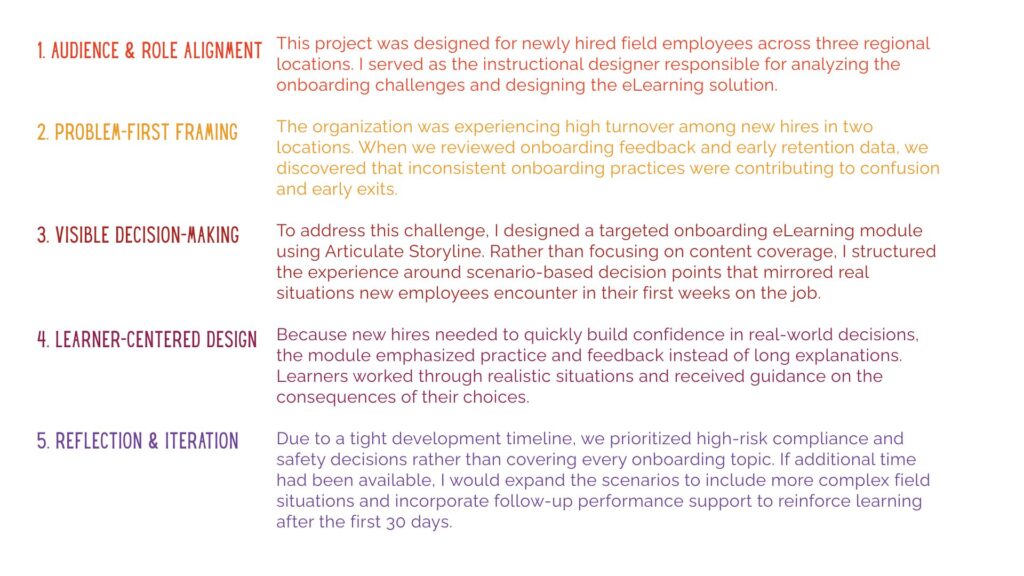
See the difference?
One shows production. The other shows professional reasoning. That reasoning is what builds trust.
Why Designers Hide Their Thinking
Many instructional designers unintentionally underplay their strategic decisions because:
- They assume hiring managers care more about polish.
- They feel their projects were “just standard.”
- They worked within tight constraints and think that makes the project less impressive.
- They are used to academic-style case studies rather than business framing.
Ironically, constraints and trade-offs are exactly what demonstrate expertise. Anyone can design with unlimited time and budget. Experienced professionals design within reality.
Your Portfolio Is Not a Museum
It is not a showcase of finished artifacts, but rather, a narrative of how you solve learning problems.
When Christy Tucker shared that only 4 out of 70 applicants had a portfolio, what struck me most was not the low number. It was the opportunity. If most candidates are not clearly demonstrating their thinking, the bar is not perfection; The bar is clarity.
That is exactly what we unpacked in our Training Magazine Network session: 5 Portfolio Mistakes Instructional Designers Keep Making and How to Fix Them. If you missed it, reply to this message and I will send you the recording link and handouts.
We shared how to structure your projects so hiring managers can see:
- The problemYour decisions
- The learner-centered strategy
- The outcomes
- Your reflection and iteration
Because when your thinking is visible, your value becomes obvious.
And obvious gets interviews.
Want to go deeper? Join Christy Tucker and I for our portfolio course, Create a Portfolio That Gets You Hired: A Step-by-Step Course for Instructional Designers? You can learn more here. The next cohort starts March 30.