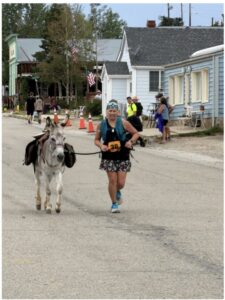
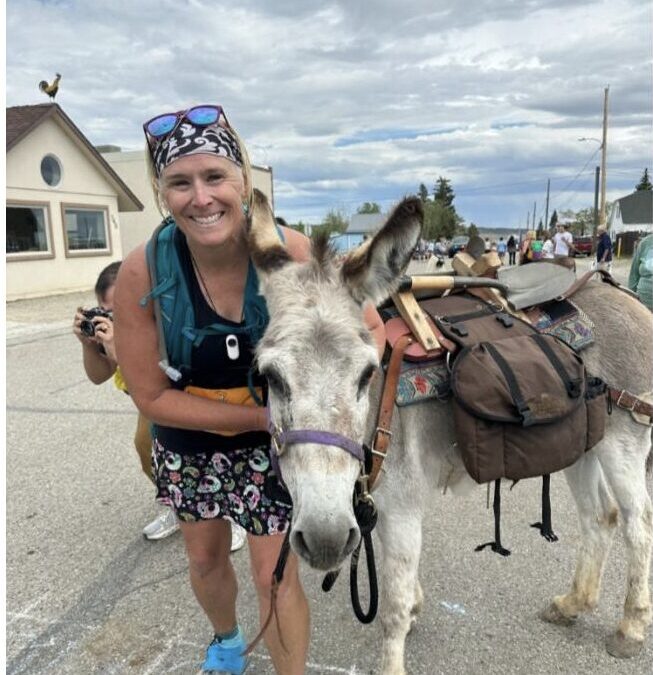
Last weekend I ran the short course pack burro race in Fairplay, Colorado, with Josie the burro, and it might be the toughest race I’ve done, ultras included.
When I crossed the finish line, exhausted and a little wobbly, a stranger walked up, congratulated me, and asked the question every finisher dreads and loves in equal measure: “So, what did you learn?”
My honest answer? “Turn right, not left.”
About a mile in, I followed a small herd of teams down the wrong fork and traded the 12.3 mile short course for 13.8 bonus miles I did not sign up for.
If you don’t run trail, this probably sounds like a rookie mistake. It’s not. Trail marking is genuinely hard. Someone has to hike or run the exact route ahead of time, mark it, and then hope nature doesn’t quietly undo their work before race day. Add in rough terrain, and even a well-marked course can have a marker that’s easy to miss if your attention drifts for half a second. Mine did.
Here’s the thing nobody talks about. That wrong turn is not so different from a lot of what happens in instructional design. You build the clearest path you know how to build. You mark it as well as you can with the information, time, and budget you have. And still, somebody follows a herd down the wrong fork, because the terrain was rough, the signal was subtle, or the “obvious” marker only looked obvious to the person who placed it. That’s not failure. That’s just the work. The goal was never a perfect course. It was building something clear enough that most people find their way, and resilient enough that a wrong turn doesn’t end the race.
A little Colorado history
Here’s the thing some don’t realize when they first hear “pack burro racing.” It sounds like a novelty. It is not. It is Colorado’s only native sport, born entirely out of necessity in the 1800s.
Back in the mining days, prospectors used burros to haul their gear through the mountains, picks, pans, shovels, and all. The animals carried the load, which meant the miners couldn’t ride them. They walked. Or ran, depending on how badly they wanted to beat the next guy to the claims office.
Legend has it the whole sport traces back to one very Colorado moment. Two miners struck gold in the same spot at the same time. Whoever got back to town first got to file the claim. Neither one could ride his burro since it was already loaded down with supplies, so they ran the whole way, animal in tow.
That story turned into tradition, and the tradition turned into an actual race. The first official pack burro race ran in 1949 between Leadville and Fairplay, a brutal 23-mile route over Mosquito Pass that tops out above 13,000 feet. In 2012, the state made it official and named pack burro racing Colorado’s summer heritage sport.
The rules still nod to that mining history today. Every burro carries a pack with a pick, a pan, and a shovel. You cannot ride your burro, no matter how tempting that gets around mile ten. You can lead it, push it, or occasionally negotiate with it, but you are running this thing on your own two feet, same as those miners did a century and a half ago.
This is why the sport only really exists here, and why it means something different than just another trail race. You’re not just running a course. You’re tracing the exact kind of stubborn, scrappy problem-solving that built these mountain towns in the first place. Fitting, honestly, for a sport that requires exactly that same stubbornness to finish.
How I ended up here
I first heard about pack burro racing in the early 2000’s when attending the Colorado Sport Hall of Fame and one of the inductees was a female burro racer. I was intrigued to say the least, but insert raising kids, working, and life, and it wasn’t until the summer of 2025 when I got another spark to learn more. In July 2025, I went to Fairplay for Burro Days with Rocky Mountain Glampers, the local women’s camping group I camp with all summer and decided to check things out. Nothing more. The only goal was to see how it all worked.
I had questions. A lot of them.
- How does a pack burro race work?
- Do you have to own a donkey?
- If you don’t, how do you even participate?
- And if training is required, what does that actually look like?
By the time I left Fairplay, I’d talked myself out of the burro race entirely. I decided I’d try the llama race instead. Llamas don’t require training. That felt like a commitment I could actually keep. And, side note, I did. I ran that on Saturday of Burro Days this year.
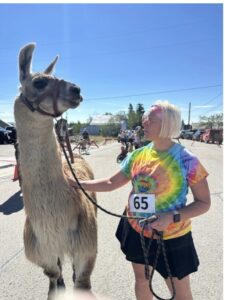
Now, back to the burros…
Fast forward to January 2026. I joined a burro running Facebook group, mostly to lurk and learn. Then in February, Amber, owner of ReDONKulous Ranch posted about a twenty-dollar hauling fee to try it out.
Well. I was in. I did my first training run on February 15, 2026. I wrote about that one here. I ran with Winnie and was hooked before we’d gone half a mile. Although my lungs were on fire, I loved it. Turns out these animals are quirky, sweet, and completely capable of stealing your whole heart on the first outing.
By my third or fourth session, I was starting to get the hang of it, or what Amber, the owner of ReDONKulous Ranch, calls becoming “burro brave.”
My first race was the Idaho Springs Burro Race in May 2026..
What Fairplay Taught Me this Time
Beyond the right turn I should have taken, here’s what stuck with me, on the trail and off it.
- Donkeys are wildly misunderstood. They’re sweet, sassy, and smarter than people give them credit for. Less stubborn, more intuitive. I think about how often we make the same mistake with new learners, new tools, or new stakeholders. What looks like resistance is usually just a creature, or a person, that hasn’t been given a reason to trust you yet.
- Learning a new sport at this stage of life has been exactly what I needed. As our girls grow up and build their own independent lives, I’m relearning how to do the same thing for myself. There’s something clarifying about being a total beginner again, especially when your day job requires you to be the expert. It’s a good reminder of what our learners feel every single time we hand them something new.
- I’m a learner at heart, and this sport keeps proving it. Saddling, handling, reading a trail with an animal beside you instead of just under your own feet. None of them are instinctive. All of it must be learned, usually the hard way, usually with someone patient enough to walk you through it more than once. That’s the whole job, isn’t it. Building the thing that walks someone through it more than once, so they don’t have to learn it the hard way alone.
- I am not a fast runner, and this sport has made peace with that for me. I’ll likely finish in the bottom third every time. I show up anyway. Progress that isn’t flashy is still progressing, and that applies just as much to a course revision that quietly gets better with every round of feedback as it does to a race you don’t win.
- Trail running with a burro is more mental work than physical. The legs matter. Patience matters more. Same as building learning that sticks. The instructional design is rarely the hard part. Managing humans, timelines, and your own expectations along the way, that’s the real endurance event. \
I have so much gratitude for this sport, these animals, and the strange, wonderful world of pack burro racing that I somehow stumbled into by way of a Facebook post and a twenty-dollar hauling fee.